
Case study / Gamblers Table
How a hobby indie game turned early traction into a strong Steam trailer
How a clear 30-second structure helped an already-promising indie game present its real progression more effectively on Steam.
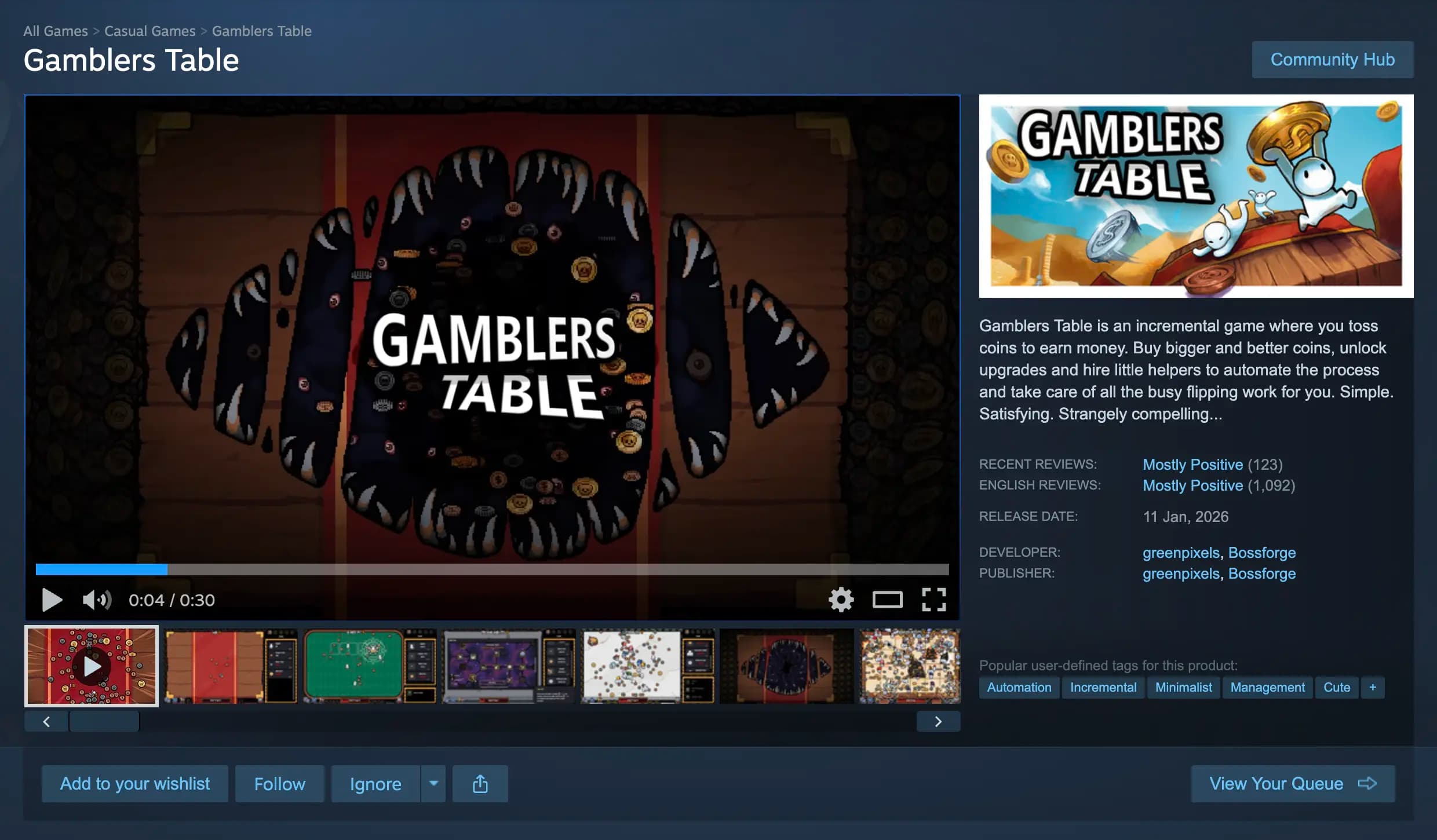
Tim came to me because his Gamblers Table trailer was no longer enough.
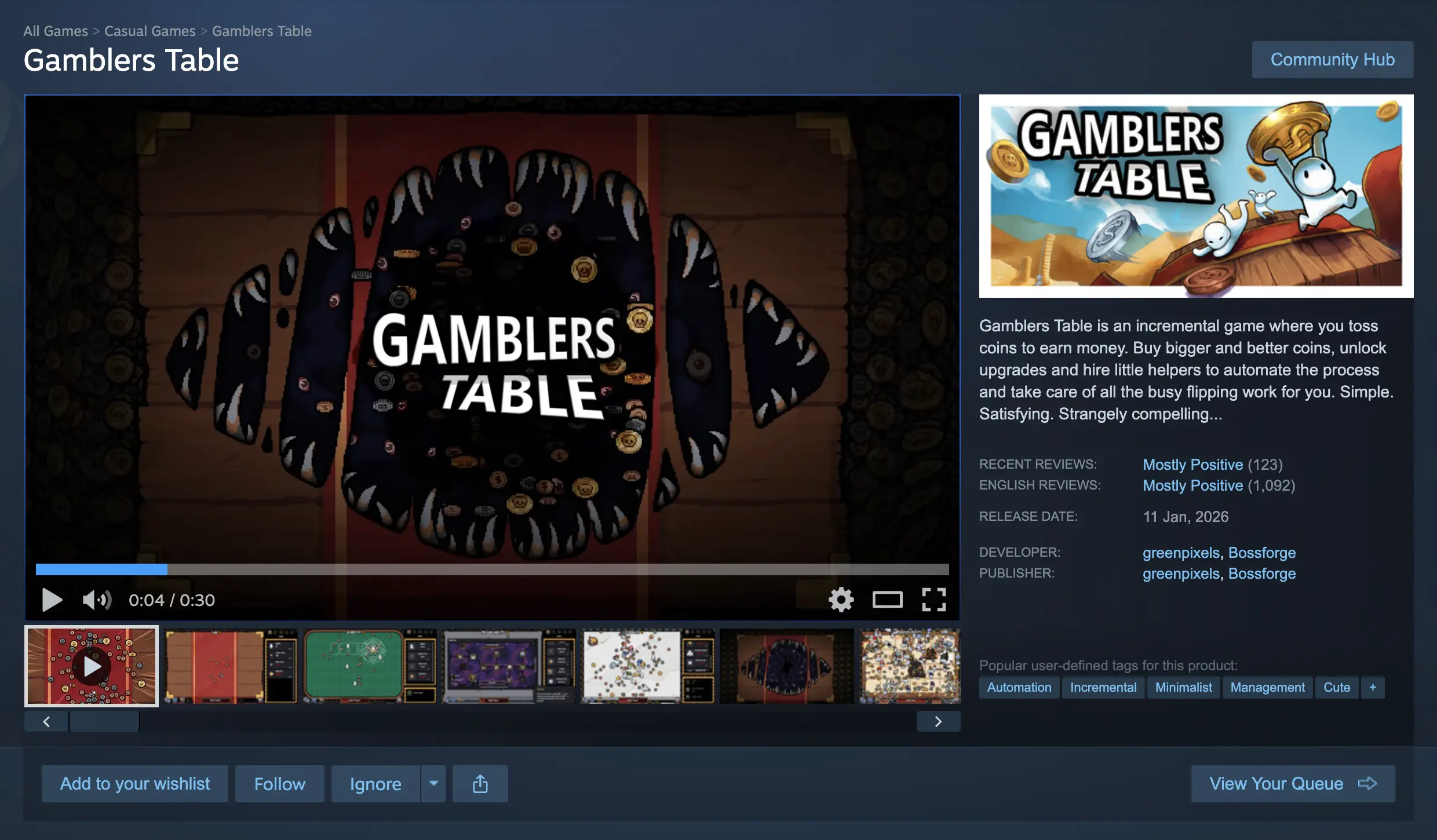
He had already done the hard part. He made a game people cared about.
What he needed was not someone to invent the appeal of the game. He needed someone to understand it, structure it, and present it clearly.
I did the trailer, delivered the project, and then I did not hear much from him again.
That was fine.
At the time, it felt like a normal Steam trailer project. Months later, I started hearing about it from other clients.
This is a case study I am writing without the client’s input. I reached out for one, but he did not respond. So I am writing only what I know, what I made, and what happened after.
The message that started it
Last July 2025, Tim messaged me on Fiverr.
He was a hobby indie developer from Germany. He had built a coin-flipping idle game called Gamblers Table, uploaded a prototype to itch.io, and watched it reach over 100,000 players without really trying.
Big YouTubers had started covering it. The attention was real.
My name is Tim. I'm a hobby indie developer from Germany. My recent game project has gotten some unexpected traction, we uploaded a prototype to itch.io, which got over 100k Players and attention from a few big youtubers. I used to cut simple trailers myself but with this amount of attention my skills just don't cut it anymore and I need professional help. I'll write down some ideas for the trailer but if you have any ideas or feedback please share them with me, I'm really not so confident in my video skills.
Tim. Fiverr order brief. July 2025.
That message already said a lot.
Tim was not coming in with a broken game. He had a working concept, real player interest, and a clear understanding of what made the game interesting.
He wanted the trailer to show three things:
- the exponential growth of the numbers
- the escalating weirdness as the game progresses
- the hidden complexity underneath a simple surface
For reference, he sent trailers from The Gnorp Apologue, Tower Wizard, and Idle Colony.
All incremental games.
All trailers that let the gameplay speak.
This is what Tim made himself before reaching out. It already helped the game get attention. But with a Steam launch ahead, the presentation needed to feel more intentional.
How I approached it
I played the game first.
Then I read through everything Tim sent.
After that, I prepared a storyboard before editing anything. I wanted the trailer to have a clear 30-second structure instead of just showing random gameplay moments.
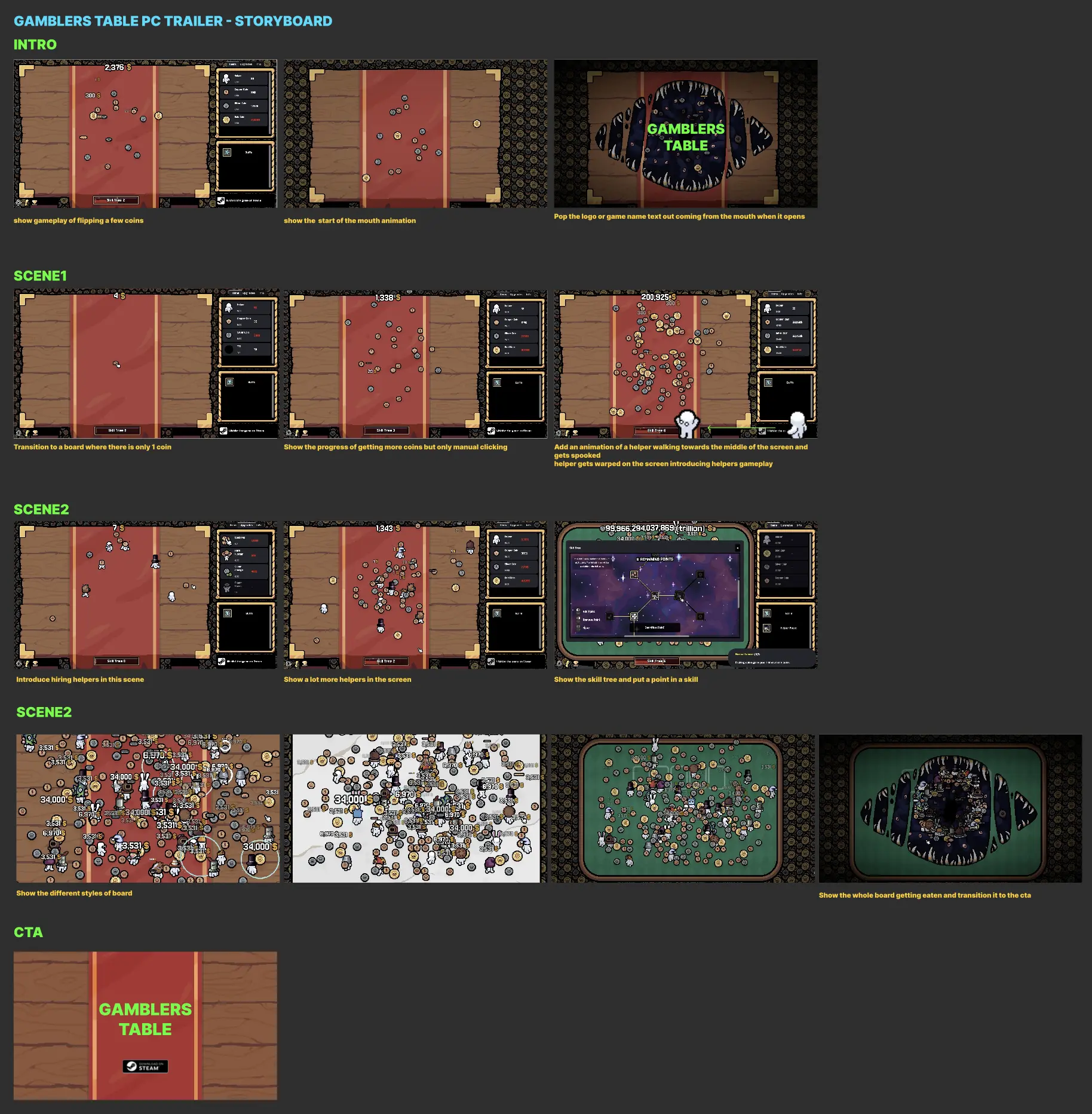
The structure was simple:
- The monster mouth opens.
- The logo appears.
- Cut to one coin on an empty table.
- Then the trailer starts small.
- One flip.
- A few numbers.
- One helper.
- Then more helpers.
- More coins.
- More systems.
- The skill tree appears.
- The board changes.
- The chaos grows.
- Then the whole table gets eaten.
That was the main idea.
Start with curiosity, reset the viewer to something simple, then let the game escalate naturally.
The biggest creative decision was the intro.
Tim mentioned the monster reset animation and asked if it could go at the end. My take was the opposite.
Open with it.
Put the strange creature on screen before the viewer even understands what the game is.
Then cut to a single coin on a bare table.
That contrast gave the trailer a stronger hook.
“Good point. I trust you on this.”
Tim. Discord. July 2025.
That was the kind of collaboration this project had.
Tim knew his game. He gave me a dev build with console access so I could unlock content and record clean footage. He even offered to add new in-game content if I needed a better shot.
My job was to take what was already there and frame it properly.
Not fake the game.
Not overproduce it.
Not make it look like something else.
Just show the real loop in a way that felt clear, strange, and satisfying.
The finished trailer. Same game. Stronger presentation.
Then I forgot about it
Genuinely.
The project ended. Tim went quiet. I had other work to do.
He autocompleted the order without leaving a review, and I moved on.
Months passed.
In December 2025, the trailer was featured in the Deutsche Indie Showcase by Gronkh, one of the biggest gaming YouTubers in Germany.
I did not know this at the time.
Gamblers Table launched on Steam in January 2026.
I still did not think much about it.
Then in April and May 2026, three different clients reached out to me for PC game trailers, and all three mentioned Gamblers Table.
They said they liked what I did with it.
One of them mentioned that it was one of the more successful games in the incremental genre right now.
That was the point where I finally checked.
The Steam page was still using the trailer I made.
The game had nearly 2,000 reviews.
The reception was mostly positive.
And the project I had treated as a normal delivery had quietly become one of the trailers people were using to judge my work.
The trailer was featured here in December 2025. I only found out months later.
What I can actually say
I want to be clear about this part.
I am not claiming the trailer made Gamblers Table successful.
That would not be fair to the game, the developer, or the audience that found it.
Gamblers Table already had traction before I worked on it. The game itself had a strong hook. The prototype had already reached a large number of players. And being featured by a major YouTube channel likely had a huge impact.
What I can say is simpler.
The game had real appeal.
Tim needed a stronger presentation for Steam.
I helped turn the game’s actual progression into a trailer that was easier to understand, easier to follow, and more memorable on the store page.
That was the role of the trailer.
Not to create demand from nothing.
But to help a good game present itself better.
By the numbers
Publicly observed after launch:
- 100,000+ players on the itch.io prototype before the trailer project
- Nearly 2,000 Steam reviews after the January 2026 launch
- Mostly positive reception
- Trailer featured in the Deutsche Indie Showcase by Gronkh
- 20+ Steam bundles featuring the title
These are public observations, not internal performance numbers.
I do not have Tim’s sales data.
I do not know exactly how much the trailer contributed.
And I do not want to pretend I do.
The real lesson
- This project worked because the game had something real to show.
- The numbers going up.
- The helpers getting stranger.
- The table becoming more chaotic.
- The monster eating the board.
- All of that was already inside the game.
- We did not need to fake the fun.
- We just needed to structure it.
- That is the part of trailer work that is easy to underestimate.
- A good trailer is not just a montage of features. It is a guided first impression.
- For Gamblers Table, that meant starting with a strange visual, pulling the viewer back to one simple coin, and then building the trailer around escalation.
- Small to big.
- Simple to chaotic.
- Curious to satisfying.
That was the story already inside the game.
I just helped bring it out.
I’ll update this if Tim gets back to me.
For now, this case study is based on what I can honestly say.
Gamblers Table was already a strong game before I worked on it. It had traction, a clear hook, and a developer who understood what made it interesting.
My role was to help shape that into a trailer that could carry the Steam page better.
No fake gameplay.
No exaggerated promise.
Just the real game, structured in a way that made the progression easier to feel.
That is the kind of work I want Quadral to be known for.
A good game does not need to be turned into something else.
It just needs to be presented properly.